What is Supercharger?
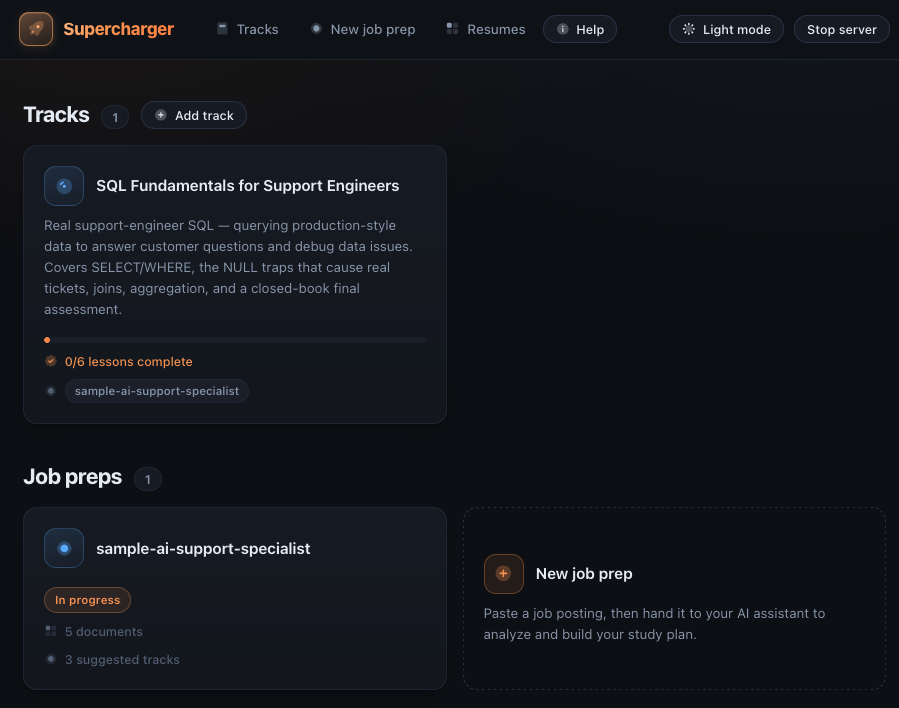
Supercharger is an open-source, local-first technical enablement tool for support engineers, solutions engineers, SREs, TAMs, DevRel teams, and junior engineers. It helps turn skill gaps, role requirements, and recurring support issues into structured learning tracks with realistic practice tickets, diagnosis drills, written responses, quizzes, Docker sandboxes, and checkpoint validation.
Support teams are constantly learning: new products, new APIs, new failure modes, new customer environments. Supercharger turns that learning into repeatable tracks and validated practice instead of scattered notes and passive reading.
The twist: Supercharger doesn’t come with a course catalog. It comes with a
contract. Your AI coding assistant (Claude Code, Codex, Gemini CLI - any
agent that can read a repo) generates the curriculum on demand, following a
documented format (SPEC.md) and quality bar (AGENTS.md). The app renders
what the agent writes: guided markdown lessons with inline quizzes, an
integrated terminal into per-lesson Docker sandboxes, structured practice
blocks for technical judgment, and automated checkpoint validation.
The core loop
Section titled “The core loop”-
Ask for what you need. Your assistant writes plain markdown/YAML content folders.
Generate a track on Go for technical support roles.Generate the prep for preps/<prep-id>/. -
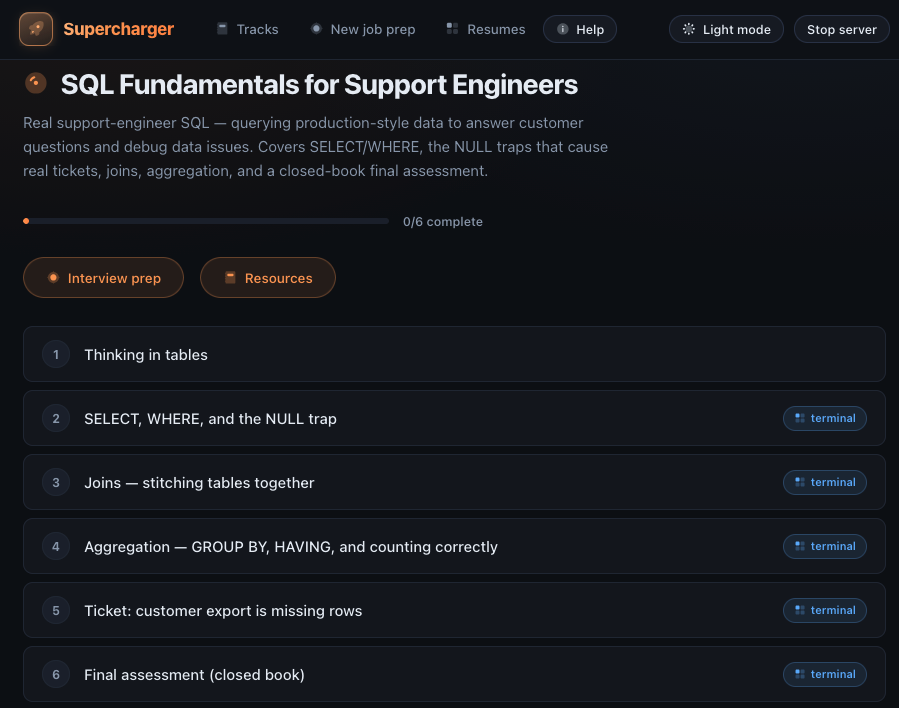
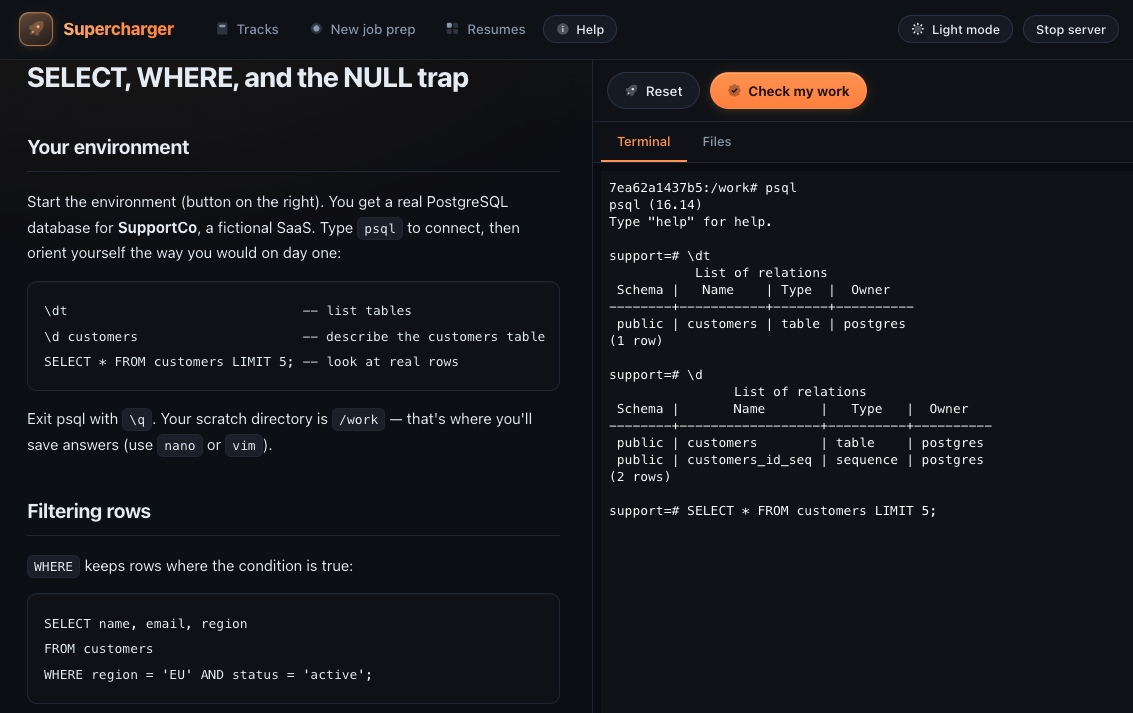
Learn in the app. Concept lessons explain the why interviewers probe, end with “explain it out loud” prompts, and quiz for understanding. Lessons can also include case files, timelines, diagnosis-before-action prompts, compare-and-explain drills, and written support responses. Hands-on lessons are framed as realistic support tickets in deliberately messy sandboxed environments.
-
Prove it. “Check my work” runs validation inside the sandbox. Every track ends with a closed-book assessment that mirrors a real screen - pass it cold and you can honestly claim the skill in an interview.
“Prepare me for this job”
Section titled ““Prepare me for this job””Paste a job posting into the app, then ask your assistant to generate the prep. You get:
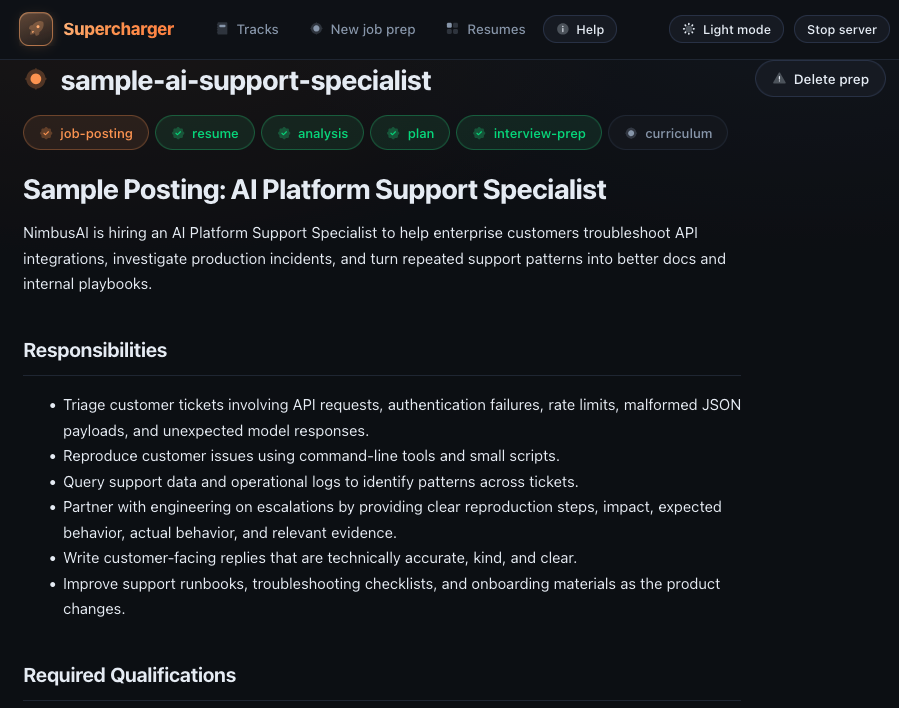
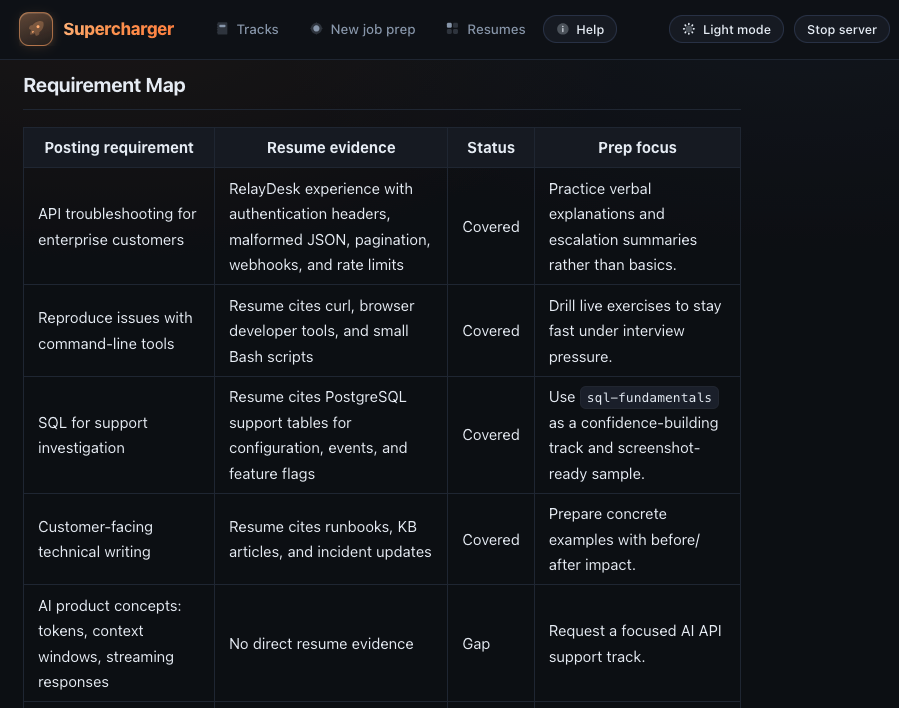
analysis.md- requirements broken into skills, with inferred requirements explicitly flagged rather than silently guessed.plan.md- an ordered study plan mapping requirements to tracks and lessons, with skim-vs-drill guidance. Missing skills get new tracks.interview-prep.md- role-specific: likely screen questions, model answers, the follow-up chains interviewers chain on, and talking points derived from reading between the lines of the posting.
What it is not
Section titled “What it is not”- Not a SaaS. Nothing leaves your machine. No accounts, waitlists, or telemetry.
- Not a content marketplace. Tracks are folders in your repo. Share them as you would any code.
- Not a replacement for production experience. A track gets you to solid practitioner depth in the common 80% - exactly what screens and onboarding often test. The long tail comes from doing the job.
- Not blind trust in generated content. Generated tracks still require human review, especially before sharing with a team.
- Not a hardened untrusted-code platform. Sandboxes are local and disposable, but they are intended for content you control or have reviewed.
Why this design
Section titled “Why this design”Supercharger treats the LLM as a content compiler with a verifiable output contract. The spec constrains the format, the quality bar constrains the substance, and sandbox check scripts validate that exercises actually work.
The assistant can generate a lesson, but the learner still has to solve the ticket, explain the evidence, write the update, and pass the checks. That is the important line: Supercharger emphasizes verified practice over generated confidence.